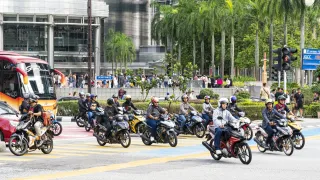

The Emergency Lane Could Become a Death Trap for Malaysian Motorcyclists
Malaysia’s highways have become dangerously predictable. Another rider dies after colliding with a vehicle stopped in the emergency lane. Just another headline?

Malaysia’s highways have become dangerously predictable. Another rider dies after colliding with a vehicle stopped in the emergency lane. Another headline. Another statistic. Another family shattered.
This week’s and last week’s fatal crashes on the ELITE Highway — where a15-year-old and a 23-year-old motorcyclist struck a stationary car left in the emergency lane — was not an isolated incident. It was part of a deeply entrenched crash pattern that has become alarmingly common across Malaysia’s road network. (The Star and The Star)
Malaysia already faces one of the highest motorcycle fatality burdens in the region. In 2025 alone, 4,340 of the country’s 6,537 road deaths involved motorcycle users — more than 66% of all fatalities. Yet motorcycles were involved in only 13.7% of total crashes. (The Star) The implication is clear: when motorcyclists are involved in crashes, the consequences are disproportionately severe. It needs to be pointed out that motorbikes are not supposed to use the emergency lane to travel in. However, this practice has since become an accepted compromise, seen to be safer for all parties on the roads.
Among the deadliest scenarios are rear-end and struck-object crashes involving stopped or slow-moving vehicles on highways. Emergency lanes — intended as protected recovery space — frequently become hazardous zones filled with broken-down vehicles, trucks, riders sheltering from rain, or unauthorized stopping. Poor visibility, fatigue, distraction, and high-speed differentials create the perfect conditions for catastrophic impacts. (ASEAN NCAP v4)
Research conducted jointly by the Virginia Tech Transportation Institute and the Malaysian Institute of Road Safety Research highlighted the scale of the problem in their paper, “Truck Struck Rear-End Crashes: Problem Scope and an Area of Opportunity.” The study emphasized that rear-end crashes involving heavy vehicles represent a major safety opportunity where technology-based interventions could save lives. (HVTT Forum)
The findings are particularly relevant in Malaysia, where motorcycles dominate the traffic ecosystem and riders are uniquely vulnerable to roadside hazards. Additional Malaysian crash studies show passenger cars and trucks are among the most common collision partners in fatal motorcycle crashes. (ResearchGate)
This is exactly why we developed RideHawk™.
RideHawk was built around a simple but urgent belief: riders need earlier awareness of danger than human perception alone can reliably provide. On Malaysian highways, hazards emerge suddenly — a stalled vehicle in the emergency lane, a truck stopped around a curve, debris after a breakdown, or traffic decelerating unexpectedly ahead. By the time a rider visually detects the threat, especially at highway speeds or in poor weather, the remaining reaction window may already be insufficient.
Traditional road safety approaches — signage, enforcement, public campaigns — remain important, but they are not enough on their own. The next leap in motorcycle safety must come from intelligent sensing, predictive alerts, and connected situational awareness.
The technology already exists to reduce these crashes. The question is whether we move quickly enough to deploy it.
Rear-end struck crashes are not “accidents” in the inevitable sense. They are often foreseeable, repeatable, and preventable. The research community has identified the patterns. The statistics have been sounding the alarm for years. And the human cost continues to rise daily.
Every time another rider dies after colliding with a stopped vehicle on a Malaysian highway, it reinforces the same reality: the system is failing to give riders enough time, enough visibility, and enough warning.
RideHawk exists to change that.
Want to learn more?
Contact:
Puvendran A/L Loganathan
📧
🌐 Motorcycle Safety Solutions Asia
Image is used under fair use for editorial and informational purposes. All rights remain with the original copyright holders.