
Improving Motorcycle Safety in Indonesia
Why Rider Risk Must Be Treated as an Operational Priority

In Indonesia, motorcycles are not just a lifestyle choice or a mode of transport. They are essential infrastructure.
Motorcycles move millions of people to work, enable last-mile delivery, and support a rapidly growing logistics and on-demand economy. Their affordability and ability to navigate congestion make them indispensable across urban and rural environments alike. Over time, they have become the backbone of motorcycle-based transport services and logistics operations. This makes motorcycle safety not only a road safety issue, but a business and operational risk issue.
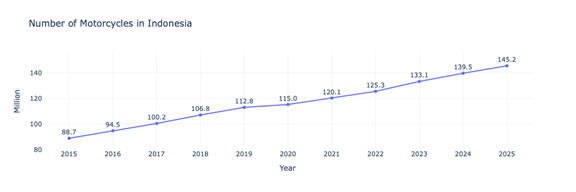
The scale of motorcycle use in Indonesia reflects this reality. The number of motorcycles has grown significantly, from around 89 million units in 2015 to approximately 145 million units in 2025.
Motorbike riders are exposed to more, higher risks when operating in mixed vehicle traffic. This risk is clearly visible in national accident data. In 2024, motorcycles were involved in approximately 1.26 million traffic accident cases, accounting for 76.47% of all incidents. This highlights a critical challenge: motorcycle safety remains one of the most significant unresolved risks in Indonesia’s transport ecosystem. With the growth of the motorbike population and demand for them as part of the logistics ecosystem, it can be expected that these numbers will also increase.
For businesses, especially those operating in logistics and motorcycle-based services, this is not an abstract issue. It directly affects service reliability, fleet productivity, and operational performance.
The consequences of these incidents extend far beyond the number of crashes. In 2024 alone, traffic accidents resulted in over 92,000 fatalities, more than 72,000 serious injuries, and over 815,000 minor injuries. Each of these numbers tell tragic stories.
These outcomes create both financial and non-financial impacts. Financially, organizations face medical costs, vehicle repairs, lost income, delivery delays, and operational disruption. Operationally, incidents affect service consistency, workforce availability, and customer satisfaction. Accidents involving branded vehicles may have negative impacts on the perception of the brand as being unsafe. On a human level, the impacts include trauma, long-term injury, disability, and loss of life — consequences that cannot be measured purely in economic terms.
From an operational safety and health perspective, the implication is clear: when motorcycles are part of how work gets done, road risk becomes operational risk.
In practice, many riders operate in conditions that resemble high-risk work environments without structured safety controls.
There are two overlapping use cases that require attention.
First, motorcycles used directly in business operations — including delivery services, ride-hailing, and field operations.
Second, motorcycles used as the primary commuting method for workers.
Addressing motorcycle safety in Indonesia does not mean limiting mobility or slowing economic activity. It means aligning safety systems with reality.
This includes integrating motorcycle use into operational safety planning, managing fatigue and schedules, supporting proper vehicle maintenance, ensuring access to protective equipment, and enabling faster, more effective incident response.
Technology also plays a critical role in shifting from reactive to preventative safety management.
Solutions like RideHawk™ are designed to help organizations detect and understand risk before incidents occur.
Motorcycles will remain central to Indonesia’s mobility and economic activity. As a result, motorcycle safety can no longer be treated as optional or secondary.
It must be managed with the same structure, priority, and accountability as any other critical operational risk.
Interested in learning more or exploring how this applies to your operations? Let’s talk:
Puvendran A/L Loganathan
www.motorcyclesafetysolutions.com
Reference